
The Principle of Cooperation (TPOCo)
Cooperation is how life works.
Cooperation is the system that turns energy into life.

Explore how cooperation multiplies energy ↓
Cooperation → more usable energy

Mammoth Hunt
One human alone cannot hunt a mammoth. A cooperative group can secure food‑energy that feeds a family, a village, an entire tribe for months.
ROI: 228:1

Leaf‑Cutter Ants
One ant alone cannot farm fungus.
A colony produces food‑energy with huge return.
ROI: 100:1

Cooperative Ancestor
A solo cell cannot generate the usable energy needed for complexity.
A cooperative cell‑mitochondria system can.
ROI: ~100× more ATP per molecule
(See Sources & Empirical Anchors below.)
The First Principle of Cooperation Revealed
Across all scales of life – human, colony, and cellular – cooperation increases usable energy. And increased usable energy is what makes complexity possible.
Energy → Emergence → Cooperation → Complexity
Think in one system.
Why This Matters
For billions of years, life has thrived through cooperation. Today, it still does – from the mitochondria in our cells to the global systems that feed and support human societies.
Life evolved as a cooperative energy system. Our bodies, our nutrition, and our social structures all reflect this design. When human systems are built as if individuals operate in isolation – physically, nutritionally, or socially – they create friction. Energy is wasted on competition, duplication, and internal drag. Life does not work that way. Cooperation is the invisible structure that makes energy usable, complexity possible, and stability real.
Understanding this principle gives us a clear way to organise human systems. Conflict becomes visible as wasted energy. Peace becomes visible as structural efficiency – a state where specialised roles align and the whole system works with less friction.
Cooperation is how life works. Recognising this pattern helps us build human systems that work with nature’s logic, not against it.
Cooperation Builds What No Individual Can Create
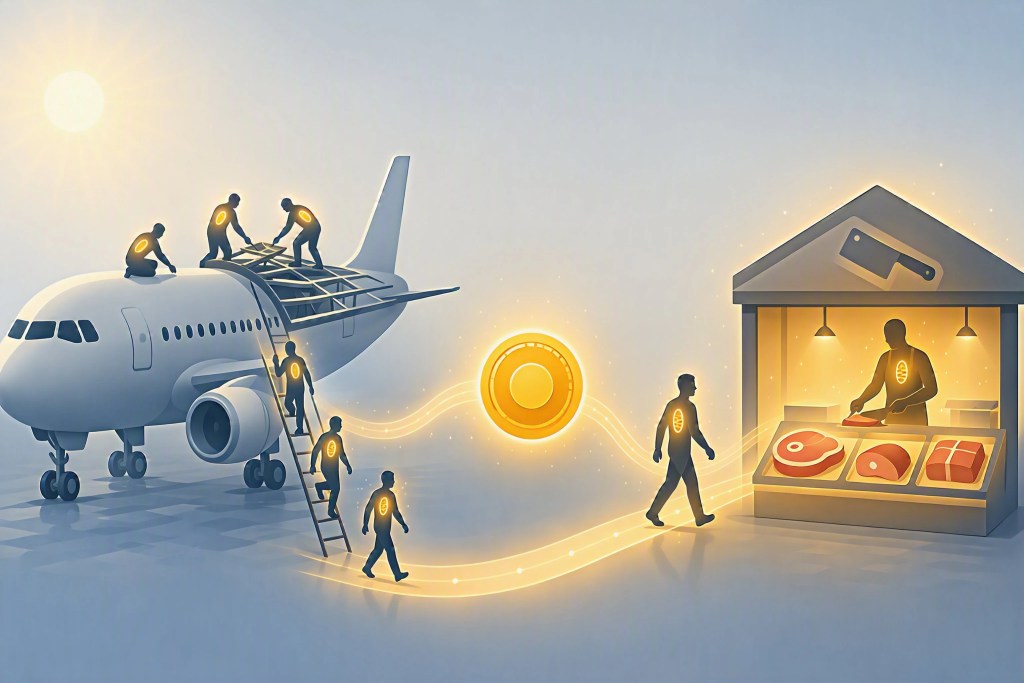
Modern cooperation looks different from the mammoth hunt, but the energetic logic is the same. No single person can build an airplane. Instead, thousands of specialists contribute small, precise parts of the work, and their effort is coordinated through companies, supply chains, and global logistics.
Rather than sharing prey, we share value through money, which acts as a proxy for distributing the energy we need to stay alive. Food is still energy. We still feed our mitochondria. However, food is now produced, transported, and delivered by large cooperative systems.
You can order a meal because millions of people are working together across agriculture, energy, transport, and technology. This is cooperation as an energy‑organising system. Each person adds a small part, and as a result, the coordinated whole produces far more usable energy than any individual could reach alone.
The airplane is a clear expression of this structure. It is the modern equivalent of the mammoth hunt: a cooperative system that multiplies energy and makes new possibilities real.
When you compare all these examples, a clear structure emerges.
The Cooperation Taxonomy

The structure of cooperation is visible everywhere — from single cells to societies. Under sunlight, life connects through shared energy systems. Cells combine into tissues, ants form colonies, humans build industries, and global systems emerge from many smaller parts working together.
The Cooperation Taxonomy captures this pattern. It is not taken from a scientific paper. It is a structural map built from observation. Anyone can see the progression once it is pointed out. The same steps repeat across biology and human society, from early cells to modern global systems.
The taxonomy shows how cooperation scales, how energy flows through these connections, and why new capabilities emerge when systems become organised.
Every species on Earth is a specialist in acquiring external energy. Humans are no different. We specialise through fragmented roles, and we coordinate these roles through money. The structure is the same across biology and society.
All of this can be summarised in two simple statements.
The First Principle of Cooperation
Cooperation emerges when available energy exceeds what individual units can capture alone.
The Cooperation Sequence
Energy → Emergence → Cooperation → Energy for Life
Energy First – The Book

Energy First explains the structure behind the Principle of Cooperation. It shows how energy shapes life, how cooperation emerges, and why the same pattern appears in biology, human societies, and the systems we build today.
If you want the full explanation, the book is the next step. It expands the ideas on this page and gives you a clear framework for understanding how energy and cooperation organise the world.
Frequently Asked Questions
📢 TPOCo is a structural explanation of how cooperation organises energy in open systems. It describes how individual units connect, form reciprocal interfaces, and create systems that produce more usable energy than any part could achieve alone. It is not a theory of behaviour. It is a framework for understanding how energy flows through cooperative structures across biology and human society.
📢 All living systems must acquire and organise energy to stay alive. Energy limits what individuals can do on their own. Cooperation increases the amount of usable energy available to the system. This is why cooperation appears again and again in evolution, ecology, and human societies. Energy is the common measure that makes these patterns comparable.
📢 For anyone who wants a clear and structural understanding of cooperation. This includes readers interested in biology, evolution, human societies, systems thinking, and AI. TPOCo provides a simple way to see how energy shapes the systems we live in and the systems we build.
📢 Specialisation is the mechanism that makes cooperation efficient.
Every species on Earth is a specialist in acquiring external energy.
Humans specialise through fragmented roles, and money coordinates these roles.
This is why cooperation increases usable energy across all scales of life.
📢 TPOCo is grounded in established scientific fields: thermodynamics, evolutionary biology, bioenergetics, systems theory, and modern symbiogenesis research. These fields describe how living systems acquire and organise energy. TPOCo brings them together into one structural explanation: how cooperation increases usable energy across all scales of life.
📢 TPOCo is a systems framework, built directly on the systems view of Donella H. Meadows: a system is not its elements but its relationships — the “and,” not the parts. Where general systems thinking describes stocks, flows, and feedback in the abstract, TPOCo identifies the specific reinforcing loop life actually runs on: cooperation is the system that turns energy into life. Energy → Emergence → Cooperation → Energy for Life is a reinforcing loop that has been turning for billions of years.
TPOCo does not replace systems thinking. It extends it — taking the relationship between energy and cooperation, an intersection hardly any science has studied, as its subject. In Meadows’ terms: every growth process she described was powered by a reinforcing loop; TPOCo names the one life uses.
All examples on this page are grounded in established scientific knowledge.
Sources & Empirical Anchors
- TPOCo Preprint (OSF) – the first scientific articulation of the Principle of Cooperation, including sources (Lichtenberg 2025).
- Mammoth hunt ROI – caloric return estimates from Pleistocene megafauna hunting studies (Larramendi 2015; Barkai 2016; Pontzer 2015; Moleón 2023; Stanford 1987; Byers 2005; Gamble 2014).
- Leaf cutter ants – agricultural energy amplification documented in myrmecology research (Wirth 1997; Hölldobler & Wilson 2010; Dussutour 2009; Bochynek, 2017)
- Energy organisation in open systems – foundational principles from thermodynamics and systems biology (cf. von Bertalanffy 1968 – dynamic equilibrium)
- Systems thinking lineage – the systems view of stocks, flows, and reinforcing feedback loops, and the principle that a system lives in its relationships (“the and”, not the parts), from Donella H. Meadows, Thinking in Systems (2008). TPOCo extends this view to the specific loop life runs on: the energy-cooperation loop. Think in one system.
- The First Principle – Modern symbiogenesis research (Lane 2010–2022; Martin & Müller 1998–2023) reconstructs the metabolic asymmetry between a low‑yield, broad Asgard‑type host and a high‑yield, narrow alphaproteobacterial symbiont, and identifies their merger as the origin of the first reciprocal precursor → ATP exchange system. These empirical findings provide the foundation for the structural conclusion expressed in the First Principle. Energy Accounting – a simple quantitative comparison of solo versus cooperative energy yields – makes this structural relationship explicit and generalisable across all cooperative systems.
TPOCo builds on these facts to introduce a new explanatory framework: how cooperation organises energy across all scales of life.